 21 Grams
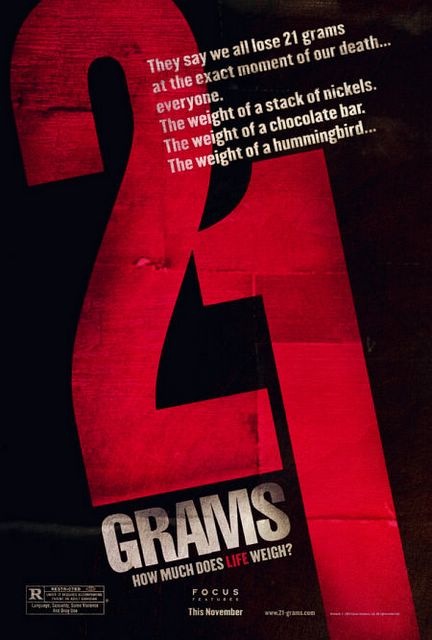
They say 21 grams is the weight we lose when we die. The weight of five nickels, of a hummingbird, of a chocolate bar - and perhaps also of a human soul.
21 Grams is the new film from the Academy Award-nominated director of
Amores perros,
Alejandro González IÑárritu. As with his previous feature, time warps the narrative structure. The storytelling moves fluidly through past and present, but always en route to the promise of redemption in the future. Viewers are active participants from the first frame. "The audience figures out as we go along what is happening and how it fits together," says producer Robert Salerno.
Reuniting with Amores perros screenwriter Guillermo Arriaga, IÑárritu once again combines unflinching gritty realism with complete faith in life's possibilities. The new film is, he says, "a meditation that explores some of the things in our complex lives: loss, addiction, love, guilt, coincidence, vengeance, obligation, faith, hope, and redemption. I like multi-dimensional and contradictory characters, as I am and as, I guess, are all human beings that I know. No one is simply good or bad. We are just floating in an immense universe of circumstances. I like to show their weaknesses and their strengths without judging them, because only then can they reveal things about our human condition."
His collaborator Arriaga adds, "There is always a moral issue in all of my work; moral in the sense that decisions have consequences. Almost all of my work is about the dead influencing the living."
The 21 Grams script, originally conceived and written in Spanish and initially envisioned but not written for a Mexico City setting, evolved through dozens of drafts into one unfolding in a Middle American landscape that would encompass universal truths. However, IÑárritu notes that "there was never a preconceived concept. I wanted to tell the story in the best way I could. It was a long process of almost three years for Guillermo and I, as was Amores perros." As in Amores perros, three individual people are linked by one accident and the narrative moves through different stages of their internal - and external - evolutions.
Many of those who worked with the director on Amores perros, such as production designer Brigitte Broch and composer Gustavo Santaolalla, were aboard the new film from early on. IÑárritu muses, "I felt like we were a rock-'n'-roll band, touring through the United States and playing a universal song."
Another returning core member of the filmmaking team is cinematographer Rodrigo Prieto, who has shot 21 Grams in what he calls an "absolutely realistic" style befitting a film whose subjects are "birth, living, and dying."
There was never any question that Prieto would not do the film. "Alejandro is like family," notes Prieto. "We've developed not only a very good working relationship but also a friendship - and, fortunately, there's no sense of competition," he laughs.
"I admire and respect Alejandro. If there's something in particular he wants in a scene, and he feels he has to get it, I know we have to get it; I know he's right and I'll do whatever it takes, because I trust his vision. He's a risk-taker and he encourages his team to take risks. He's not afraid of mistakes because even in making them you are exploring alternatives. He and I like to plan things out - we shot list, not storyboard - but when we're on the set and the actors do a different thing, we adjust."
Nearly every shot in 21 Grams was done with a hand-held camera, resulting in a heightened sense of tension that will be deeply felt by audiences. Prieto, who operated his own camera on the film, prefers the hand-held method because of its "immediacy, the sense of 'anything can happen.' I react to what the actors are doing - I mostly know what's going to happen, but I try to forget about that and just feel 'in the moment.' I try to be empathetic for what the actors are feeling. As a DP, you risk breaking an actor's particular concentration or mood by walking in with an exposure meter and giving instructions. I try to be sensitive to that as much as possible. The camera is also a witness to what's happening to these characters. When the camera is rolling, I'm right in there and I get close and intimate, and the actors have to feel comfortable with that.
"On 21 Grams, with the caliber of actors we had, it was incredible to see them perform and be the closest to them as they were doing it. I got really involved in some of the scenes and emotions, and cried once or twice."
IÑárritu notes, "We're using hand-held again [as on Amores perros] but in a different way. It gives the freedom to be more flexible in the narrative and in the style of the film. Sometimes the camera is just an observer, breathing with the scene and being very passive; other times, it can be descriptive and very active. I tried to use the camera as a painter uses his brush."
Prieto adds that the titular 21 grams "is not represented visually. Yet the characters in the movie are all close to dying, or people close to them have died. It's death that pushes things forward in their lives. Through death, they discover life.
"The story itself is shocking. Yet the images aren't screaming out at you. The overall look of the film is textured - realism, but with an edge. Life has beauty even in its roughness."
Salerno notes, "Collaborating with Alejandro means high energy. He likes to hear from everybody - his DP, his costume designer, his production designer, whoever - and then puts the pieces together. He is passionate about everything that goes into a script and a film. That energy and passion inspire the crew and the actors."
A few weeks of rehearsals preceded the start of production, and exhaustive research was the key element in both character construction and pre-production. Background research was required for every profession that appeared in the script, so hundreds of hours were spent interviewing doctors, professors, and ministers. Extras were, whenever possible, what they appeared to be; cardiologists played cardiologists, nurses were nurses. Even restaurant patrons were corralled from regulars at the eatery location. Workout enthusiasts appeared in the swimming pool and community center scenes.
Cast as Jack, an ex-con now on the straight-and-narrow for his family's sake (if not his own), Academy Award winner Benicio Del Toro first met with IÑárritu after having seen and admired Amores perros. He laughingly recalls that they initially "spoke in Spanglish. We talked about movies, directors - a lot of gossip."
From the start, Del Toro felt that the screenplay for 21 Grams "was superb. It has a lot of soul. It digs deep as drama, and it's three very human stories." Once on the set, he found the director to be "encouraging. He was like the father of our family - a good father. He got everybody together. We'd talk things through, and if he didn't understand something he'd ask."
As for his fellow actors, Del Toro notes, "When you're working with actors like Sean Penn and Naomi Watts, it makes it easier for you. Seeing Sean and Naomi do scenes while I was off-camera was never dull - I was front row at a great show."
Del Toro had worked with Penn before - though not on-screen, having been directed by Penn in two movies. He says, "Sean is great to work with as director and actor. He understands not only his character but all the characters. And with Naomi, it was like communicating without words. We all got to explore emotions."
The actor sees his own character as "a good soul who's banking on religion to secure his destiny in some ways. Some people turn to alcohol, some people turn to drugs; Jack Jordan turns to his faith. In everyone's life, there are moments that you wish you could erase, and in 21 Grams, Jack has that moment. Then he starts questioning his faith, and everywhere he turns, he's not getting the right answer. He has to re-evaluate everything he believed in."
IÑárritu notes that, similarly, Del Toro himself "questioned and analyzed every bit of the script and his character. He wanted to know a reason for everything before the shooting starts. He wants to know the character in every aspect you could possibly imagine. I began working with him five months before we started shooting.
"One of the most important things in an actor is their interior life, and Benicio has a deep one. You can see a lot of things going on in him just by putting the camera in front of his face. By doing nothing, he speaks with his eyes and a lot of things are going on. He is a cinematic animal."
Taking on the film's lead female role, Naomi Watts is Cristina, a now-affluent wife and mother who has overcome a drug-dependent past but now faces a devastated present and an uncertain future. As one of the many who had been "blown away" by Amores perros, Watts states, "Alejandro was the main draw. He and Guillermo came to see me while I was shooting The Ring. The 21 Grams script was still being worked on, but I said, 'Sight unseen, I will commit to it now. Count me in.'
"When I later got the script, I read it and thought, 'This is the second brilliant role of my life,' after Mulholland Drive. It's a very difficult journey that the characters go through, there is suffering but also the realization of how valuable our lives are; we only have this one, now. Cristina goes through so many emotions. I loved her right away; she's a beautiful soul."
Watts also immediately took to IÑárritu's mandates of authenticity, research, and preparation. "I trusted Alejandro. He wants to see what's possible. It was challenging every day; the emotional stakes were so high, and I wanted to create a character with real backbone. I developed Cristina during the rehearsal period and with my own research.
"I found my way into group therapy meetings of parents who have lost children, where I deeply connected with one woman. I feel I was able to come a little bit close with my portrayal, but that pain remains unimaginable..."
"It was like working with an open heart," IÑárritu remembers. "Naomi lost her voice a couple of times during the shoot. She gave her all in every take. She has an amazing range, and can improvise with the material expertly."
Of working with her fellow actors for the first time Watts notes, "We had a great rehearsal period. Benicio is fantastic and I respect his work. We both understood each other's process; given the state of our characters, we didn't hang out so much together.
"I've admired Sean's work for 20 years. His role is more reactive than mine, so there was an intense dynamic. Working together, I felt I could rely on him."
Penn stars as Paul Rivers, a mathematician who is grappling with - all at once - his marriage and his mortality until a new lease on life radically redirects his priorities.
IÑárritu enthuses, "Working with Sean Penn is like playing soccer with David Beckham or riding a bicycle with Lance Armstrong - the level of the game is immediately raised or is above your expectations. He doesn't rationalize; he's just intuition and pure emotion. We read, discussed, and rehearsed a couple of times and he got and absorbed everything.
"He gives it life right in front of your eyes, like a magician. He has a unique, quiet, and internal process; he doesn't like to rehearse or think too much in advance. He's one of the most sensitive, intelligent, genuine, and generous guys that I have ever known. That kind of integrity is a very strange thing to find in this business."
When asked what drew him to 21 Grams, Penn responds, "It's as simple as this: a very adventurous narrative, very human characters, and a director whose first film had struck a very serious chord with me. The aggressive nature of Alejandro's filmmaking, in the way that it harmonizes with very real characters and circumstances, really gets me going."
Penn adds, of the actor he'd directed prior, "Benicio is one of my favorite actors working today. He has so much weight and soul on-screen. He's endlessly inventive, a gem."
Of Watts, with whom he has since completed a second movie, Penn states, "I loved working with Naomi. Loved it. Loved it. Loved it. She's spontaneous, smart, hugely talented, and totally devoted to her work. A bar raiser (and a bar raiser)."
21 Grams commenced 11 weeks of principal photography in December 2002. Shooting took place primarily in Memphis, Tennessee, although no specific city is cited in the final script or the finished film. Prieto explains, "We didn't want this to be 'Memphis, Tennessee' where the story is happening, but any place in America - or in the world, even. The script is these characters and what they're living."
Although not specified on-screen, all filming was done in actual locations and places. Among the Memphis locations that were used in the film were the Grace-St. Luke's Episcopal School's gymnasium (for the swimming pool sequences), Windyke Country Club, the North End restaurant, and the upscale Chickasaw Gardens neighborhood.
The real-life locales' wintry authenticity impacted the actors from the moment they arrived to begin work. "It started to get cold when I was there, but when Naomi and Sean began shooting their stories, it got really cold," laughs Del Toro.
Watts says, "Memphis was great. It was a beautiful backdrop for our film. Alejandro wanted a sparseness that wouldn't interfere with the story."
Salerno explains, "All these practical locations gave our actors a sense of where they were and allowed them to feel reality and presence. It was very much about creating an environment for them - and for Alejandro, who likes to feel the energy of where he's at. We could have built a set for the funeral home, for instance, but there is a vibe when you walk into the actual funeral home we shot in - which we wanted, and got."
Given the movie's Middle American setting, Memphis provided the necessary diversity of people and locale to color every frame of 21 Grams. IÑárritu found it to be "unique, and quite different from all the cities in the United States that I've known and visited. It reminds me a little bit of a Latin American city. Memphis has a strong personality and the people there still have their feet on the ground. It's the heart of America, with a nostalgic sad feeling. You can hear the blues in the air, plus the strength of the Mississippi River."
Prieto notes that the movie came to inevitably reflect "the atmosphere and the texture of the city. We show its character. I fell in love with the city, its great visuals, and also its people. There are all levels of social classes in Memphis, and in this movie. It has contemporary buildings yet it feels like an old city."
Screenwriter Arriaga cites William Faulkner as a profound influence, one whose works he has taught. While on location in Memphis, Arriaga took the time and opportunity to make a pilgrimage to the famous writer's home/shrine in Oxford, Mississippi.
For production designer Brigitte Broch, another collaborator on Amores perros who rejoined the creative team for 21 Grams, Memphis "is history, authenticity, and soul. Based on a gut feeling from Alejandro, Rodrigo, and myself, we chose Memphis. There were different architectural styles here that offered us a lot of possibilities, different layers of textures. The houses are not generic; at every social level, we wanted the environments of each character to talk for them, and Memphis had what we needed. 21 Grams gets down to the roots of human suffering and resurrection - the scenes are so intense - and that's this city."
The final two weeks of the shoot took place near Albuquerque, New Mexico. An entire week was spent in and around a bare-bones motel in the town of Grants, a narrow, one-street settlement. Another Albuquerque location was on the Zia Pueblo territory, a bramble bush-and-scrub grass wasteland of surprising majesty. Salerno notes that the New Mexico locales offered "a desert starkness, which was the big contrast from Memphis that we wanted and needed at that point in the story."
As for the interiors, the filmmakers' mandates of research and authenticity meant that if a scene unfolded in an office, and there is a desk whose drawers would never be open on-camera, Broch and her team still filled them with objects pertinent to the officeholder's profession and personality. "There is a total base of confidence between Alejandro and myself. If there is no back story provided for the character, I create it myself," she notes. "I know - 'method actors' work the same way."
For Broch, each set's design, furniture, and props "all have to have a reason to be there. That reason translates as the reality of the person who will occupy it. Alejandro, Rodrigo, and I work closely together. I prepare a presentation, and the three of us go through the material. We talk about the colors. We talk about the moods and textures. Ours is the teamwork of three people who will ultimately agree on what the final product should look like by taking an overall view."
Prieto adds, "Brigitte incorporated colors that we talked about into the set designs. The visuals change to correspond to the emotional arc of each story and its characters - and they help you see where you are in the overall story. We divide the three stories color-wise because of the structure of the movie. There are subtle cues for the audience to know; this is Paul's world - a cooler blue; this is Jack's world - a yellow red; and this is Cristina's world - sort of in-between, with red and golden but mixed with some of the blue of Paul's world."
"The different stocks of film give different textures to the characters, depending on their emotional stage at that point in the film," notes IÑárritu.
Prieto elaborates, "When things start to get more difficult for our characters, we'd go to a grainier stock When things feel a little cleaner or better, the stock isn't as grainy. The framing and camera work reflect that, too - when things are in balance for the characters, we use more traditional framing."
But the overall visual palate is also unified by a bleach-bypass process deployed in the development of the film's negative. "It's the way I grew up seeing the colors of my country," explains IÑárritu. "Rodrigo and I discussed this before filming began. There were some still photographs that we saw which inspired us, too."
As this approach was factored in early on, notes Broch, the team made allowances that "our purples went into brown, or our reds went into black. Rodrigo is fantastic to work with, and it's obvious that it's more important that I adapt my work to his - what he needs for his lighting."
Costume designer Marlene Stewart adds that since 21 Grams required "very specific color requirements for the way the film stock was processed, that took precedence in my choices. The processing was very high contrast, so it was better to have colors in a medium range - as if for a black-and-white movie."
Stewart accommodated the shifting styles of the story's characters. Costume choices were made more along the way in the dramatic and filmmaking processes, rather than being set in pre-production. She notes, "If you come to the table with preset ideas, a lot of the time you are going to get frustrated. You need to discuss visions with the director and the actors - and, in terms of color requirements, the production designer and the cinematographer. The creative process gets everybody's ideas together.
"Alejandro stressed creating looks for the characters that didn't overwhelm the viewer, that didn't force the viewer to jump too quickly to conclusions about the characters. This helps make the story applicable to everyone."
Stewart was regularly called upon to present the actors with a variety of clothes choices as they reached each new level of dramatic character development, since their tastes evolved over the course of the portrayal. This was another benefit of the chronological shooting schedule that afforded the cast and filmmakers the creative opportunity to start at the beginning and grow together. "This was a different kind of movie for me," admits Stewart. "A lot came together at the last moment; I'd create right there on the spot. The director and I always tried to make the actors feel comfortable. That worked particularly well on 21 Grams, where everybody made suggestions and worked it out together."
Salerno says, "When shooting, Alejandro will keep working with the actor and do a bunch of takes. Together, they get to the point where he has what he wants - he doesn't settle - and the crew and the actors have gone beyond what they might normally do. All of these actors were dynamic; I considered it a privilege to be able to watch them in their processes."
Operating the camera throughout, Prieto found the actors' respective approaches to their roles never less than fascinating. "Sean is always interested in and aware of what we're doing with the camera. He needs quiet and complete concentration for his character and the moment. He's amazing - and also very generous to everybody."
Watts comments, "Rodrigo's camera is like another character in 21 Grams. He is moving the camera the whole time, and it's incredibly liberating for an actor to not have to concentrate on focus marks."
Prieto confides, "Naomi is very sweet - and she never had any complaints about the camera. I don't know how she does it, but you don't see her working. She becomes the character - she'd step in front of the camera and it wasn't Naomi, it was Cristina." Salerno adds, "It's unbelievable what she pulls out. She's wrenching in this film."
As for Del Toro, Prieto echoes IÑárritu in praising the actor for "finding and exploring things that are not written. He's very subtle. He gives the characters he plays lives of their own. It's great to look into his eyes - lighting his eyes was something I enjoyed doing, and when we were able to put that glint into his eyes, things came out that projected incredibly. Benicio knows how to project - how to balance when the camera is further away, but when you get close enough there's an intensity that far away you wouldn't notice..."
On board early on, as a self-described "observer" during production, the film editor of 21 Grams is Stephen Mirrione - who, as an Oscar winner for his work on Traffic, was already well-versed in shaping a compelling narrative with Benicio Del Toro portraying one of the central characters. But, as Mirrione says, "21 Grams is an emotional narrative driven by what's going on within the characters - passions and emotions - rather than a plot-driven narrative.
"I'm pretty comfortable with that type of storytelling; it gives me the freedom not to be a slave to the plot, so I'm able to focus on capturing one particular emotion in a scene, to zero in on moments. I put myself into the characters' heads. That makes it interesting for me as an editor. I do watch the dailies and make sure I don't forget certain things. Alejandro doesn't want a single moment in the movie wasted; he was constantly letting me know what he was going for and what he was looking for. He puts himself into everything. Scenes were shot in every setup you could imagine, so we had a lot of options. I took my cues from what the actors and the camera were doing - Rodrigo also puts a lot of himself into it."
Mirrione notes, "The challenge to editing a movie like this is that everyone is going to watch this and initially react in a different way. But they won't have to know or be expecting this or that to happen, because this movie will pull you along. It's going to impact everyone a little differently. You are feeling 21 Grams as it's happening. Then, at the end, when it's over, there will be the same overall emotional impact - it hits you."
Prieto says, "21 Grams is the kind of film that you think about for days after you see it. It's about subjects that we all ponder, and this movie shows them in a very immediate way."
"21 Grams is about how we find hope, forgiveness, and redemption," states Del Toro.
"Everyone - in every culture - experiences these basic human emotions and dilemmas," comments Stewart. "That's the door to this movie."
Broch adds, "We all put our hearts into making 21 Grams. We knew we were doing something special."
Watts says, "21 Grams takes you to a place of hope. There is hope even in the most trying circumstances."
Further reading>>
Keeping the Innocence With "21 Grams"